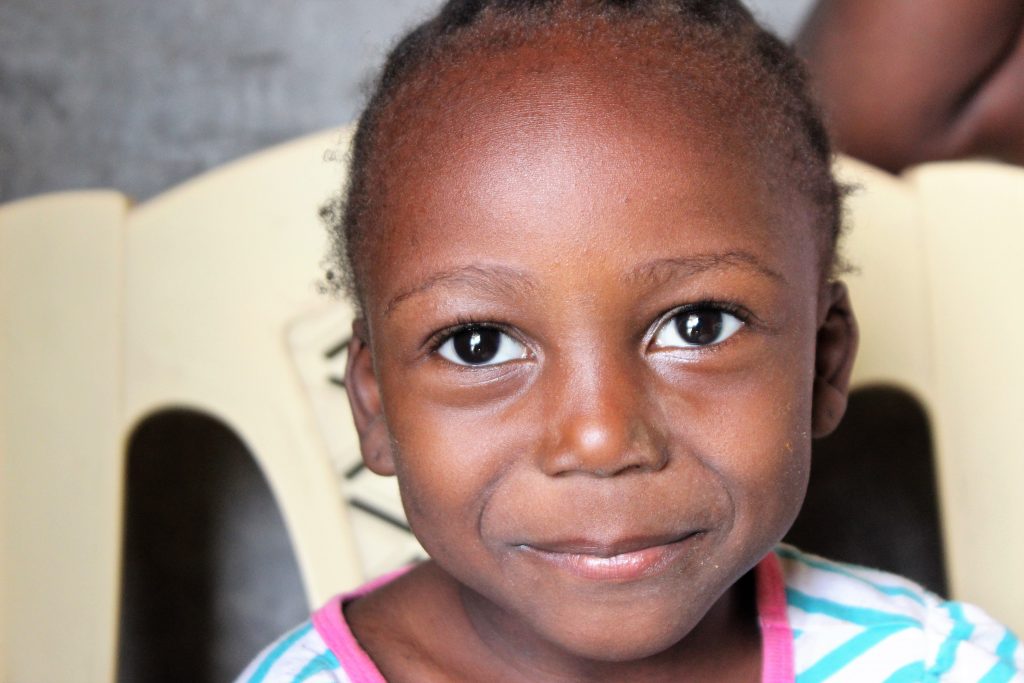
Chelsea at her grandmother’s shop in Kambi Muru, Kibera
Three-year-old Chelsea’s eyes shine bright, twinkling like two little stars. She is so full of joy that everyone around her cannot help but be happy too. She skips up and down on seeing Violet Chemesunde, a Community Health Volunteer (CHV) whom she has come to know quite well.
Chelsea’s grandmother Norah describes how in mid-March 2016, Chelsea would pant for breath and sweat heavily at night. She lost her appetite and consequently lost quite a lot of weight. Chelsea’s mother initially claimed that she had asthma. However, her grandmother felt that there was more to this than just asthma. The situation got worse, but she did not give in to despair.
She decided to take her to a health facility in Kibera for a medical check-up. There she was treated for pneumonia and medication was given. In addition, Norah was referred to St Mary’s Hospital for further investigations. There, a chest X-ray was done alongside a HIV test.
That is when Chelsea was diagnosed with TB. She was immediately started on treatment for six months, through to September 2016. The other three children under Norah’s care were also tested for TB and the tests were negative.
Norah had to ensure that Chelsea took her medications appropriately and on time. She would administer the medication every day at 3.00PM and was very optimistic that Chelsea would make a full recovery.
“For the first two months, I gave her four tablets. For four months after that, the medication reduced to two tablets. Chelsea was not afraid of taking medicine,” Norah says smiling at her granddaughter. “This made it very easy for her to take her medication.”
Sigh of Relief
Two days after she started her medication, Chelsea experienced some relief. She slept soundly for the first time after difficult nights. Before, her cough was so bad such that she often fell off her bed when she experienced a bout of coughing. With continued use of the medication, Chelsea’s cough ceased, and the night sweats reduced drastically. However, she still continued to lose weight and became feather-light. This prompted her grandmother to seek nutritional advice.
Chelsea was so malnourished that she had to be given porridge and peanuts to supplement her daily diet.
“Violet would visit me every week, sometimes even twice in a week,” she says referring to the CHV who supported her through the whole journey.
Violet Chemesunde is a CHV who is very passionate about health issues. She is attached to Kibera South Health Centre and conducts health education and home visits within Kibera. She educates the community on adherence to medication, hygiene, contact tracing, modes of disease transmission and prevention and referring presumptive cases to the health facility for screening.
To successfully carry out the tasks of a CHV, one needs to build trust and become more of a friend to those they support. Her friendship with young Chelsea is evident as she plays around her.
Finding Children with TB
Kibra Sub County TB and Leprosy Coordinator, Sarah Chandi says, “I work closely with the CHVs in contact tracing and defaulter tracing.”
She reiterated that CHVs have been instrumental in Active Case Finding in Kibra Sub-County. They refer all presumptive TB cases to the nearby health facilities and follow up to ensure that the confirmed cases are not lost.
Chelsea, who was among the first children to be treated using child-friendly TB medicines before the national rollout, has completed her treatment and is cured. She is now an active and healthy girl in kindergarten and doing well in school.
Previously, children with TB like Chelsea did not have access to TB medicines in a form that was easy for them to take. Caregivers like Chelsea’s grandmother Norah had to split and crush multiple pills to achieve the right dose for children. Children had to swallow the bitter-tasting pills, which were not soluble in water. It was difficult to determine whether they were receiving the correct dose of medicines. Ultimately, this made TB treatment ineffective and increased the rates of drug resistant TB in children.
TB Alliance and other partners developed properly formulated child TB medicines in the correct dose. The child-friendly formulation is a combination of drugs used to treat tuberculosis and is fruit-flavoured to appeal to children. Through the National TB, Leprosy and Lung Disease Program (NTLD-Program) and with the support of CHS and other partners, Kenya became the first country in the world to rollout the improved child-friendly formulations of TB drugs on a national scale.
This means that children like Chelsea can now take fewer pills, which taste better, simplifying and improving their treatment journey. In 2017, 7,771 children between the ages of 0 and 14 years of age were treated for TB.