
COVID-19 information and response
  • HOME
  • WHO WE ARE
    • About Us
      • CHS is a local, not-for-profit organisation. We understand the local context, make use of local expertise and strategic partnerships to ensure we implement evidence-informed solutions and interventions to existing and emerging public health concerns.
      • Learn more >>
    • More About Us
      • Our Approach
      • Our Strategic Goals
      • Our Solutions
    • Leadership & Partners
      • Board and Leadership
      • Partners
  • WHAT WE DO
    • Our Solutions
      • CHS continues to grow as the preferred partner for health solutions by consistently focusing on the delivery of quality services and continuous improvement in a transparent and accountable manner.
      • Learn More >>
    • Current Programmes
      • Tamatisha TB
      • Shinda Tena
      • TIBU LIMS Secure Sync Project
    • Our Impact
      • Our Impact
      • Focus Areas
      • Tuberculosis in Kenya
    • Past Programmes
      • TIFA Project
      • TB ARC II
      • TB ARC
      • Diagnostics Project
      • Tibulims Project
      • Ezesha_99DOTS Project
      • Tegemeza Plus
      • Shinda
      • Tegemeza
      • Naishi
      • Fikia
      • Afya Info
      • ALHIV Adherence Initiative
  • MEDIA CENTRE
    • News
      • CHS continues to grow as the preferred partner for health solutions by consistently focusing on the delivery of quality services and continuous improvement in a transparent and accountable manner.
      • View >>
    • Blog
      • CHS continues to grow as the preferred partner for health solutions by consistently focusing on the delivery of quality services and continuous improvement in a transparent and accountable manner.
      • View >>
    • Personal Stories
      • CHS continues to grow as the preferred partner for health solutions by consistently focusing on the delivery of quality services and continuous improvement in a transparent and accountable manner.
      • View >>
    • More
      • Video Gallery
  • RESOURCES
    • Papers
      • CHS continues to grow as the preferred partner for health solutions by consistently focusing on the delivery of quality services and continuous improvement in a transparent and accountable manner.
      • View >>
    • Job Aids and Tools
      • CHS continues to grow as the preferred partner for health solutions by consistently focusing on the delivery of quality services and continuous improvement in a transparent and accountable manner.
      • View >>
    • Best Practices
      • CHS continues to grow as the preferred partner for health solutions by consistently focusing on the delivery of quality services and continuous improvement in a transparent and accountable manner.
      • View >>
    • More
      • Annual Reports
      • Newsletters
      • Publications
  • GET INVOLVED
    • Careers
      • CHS continues to grow as the preferred partner for health solutions by consistently focusing on the delivery of quality services and continuous improvement in a transparent and accountable manner.
      • View Careers >>
    • Partner With Us
      • CHS continues to grow as the preferred partner for health solutions by consistently focusing on the delivery of quality services and continuous improvement in a transparent and accountable manner.
      • Learn more >>
    • Subscribe
      • CHS continues to grow as the preferred partner for health solutions by consistently focusing on the delivery of quality services and continuous improvement in a transparent and accountable manner.
      • Subscribe >>
  • CONTACT US
+321 123 4567
info@test.com
My Account

Get Ready for Plain Tobacco Packaging

Posted on May 30, 2016

On May 31 every year, CHS joins the Ministry of Health, WHO and other health partners around the world in marking World No Tobacco Day (WNTD), highlighting the health risks associated with tobacco use while promoting effective actions and policies to reduce tobacco consumption.

According to WHO, the tobacco epidemic is one of the biggest public health threats the world has ever faced, responsible for the deaths of around six million people annually. More than five million of these deaths are the result of direct tobacco use while more than 600,000 are as a result of non-smokers being exposed to second-hand smoke. Tobacco will be responsible for the deaths of half of all its current users.

There are more than 4,000 chemicals in tobacco smoke, of which at least 250 are known to be harmful and more than 50 are known to cause cancer.

A recent survey conducted in Kenya revealed that one in every five Kenyans is exposed to second-hand smoke both at work and at home.

Nearly 80% of the more than one billion smokers worldwide live in low and middle-income countries, where the burden of tobacco-related illness and death is heaviest.

Tobacco users who die prematurely deprive their families of income, raise the cost of health care and hinder economic development.


WNTD 2016 Theme: Get Ready for Plain Packaging

WHO and the Secretariat of the Framework Convention on Tobacco Control are calling on countries to get ready for plain (standardised) packaging of tobacco products.

In a bid to increase their profits, tobacco products have increasingly been packaged in attractive colours and branding, increasing its demand. This has been done despite the obvious health risks the habit introduces to its users and those who come in contact with second-hand smoke.

This means that tobacco companies will be restricted or prohibited in the use of logos, colours, brand images or promotional information on packages, other than brand names and product names displayed in a predefined standard colour and font style.

Hard-hitting anti-tobacco advertisements and graphic pack warnings – especially those that include pictures – have shown to reduce the number of children who begin smoking and increase the number of smokers who quit.

Graphic warnings can persuade smokers to protect the health of non-smokers by smoking less inside the home and avoiding smoking near children. Studies carried out after the implementation of pictorial package warnings in Brazil, Canada, Singapore and Thailand consistently show that pictorial warnings significantly increase people’s awareness of the harms of tobacco use.

In December 2012, Australia became the first country to fully implement plain packaging.
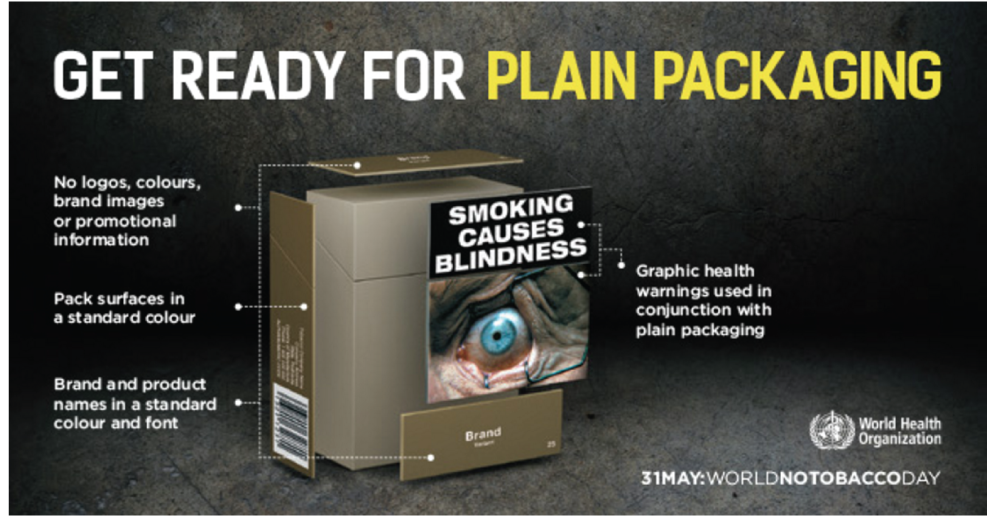
World No Tobacco Day 2016 poster

Kenya’s Strides towards Plain Tobacco Packaging

Kenya became a Party to the WHO Framework Convention on Tobacco Control on February 27, 2005, and thereafter enacted the Tobacco Control Act in 2007 as the principal law governing tobacco control in Kenya.

Read More: Tobacco Control Act 2007

This comprehensive law defines, restrictions on public smoking, tobacco advertising, promotion and sponsorship, as well as the packaging and labelling of tobacco products. Under this Act, smoking is prohibited in all public places, except in the demarcated smoking zones.

Some of the health messages that are required to appear on these packages include:

  • Smoking harms people next to you
  • Tobacco use kills
  • Tobacco harms your unborn baby
  • Tobacco use causes cancer
  • Tobacco use causes heart disease
  • Tobacco use causes lung disease, among others

Health Cabinet Secretary Dr Cleopa Mailu called for the immediate enforcement of this Act in April 2016, after the results of the STEPwise Survey indicated that over 20% of Kenyans were exposed to second-hand tobacco smoking both at home and at work.


CHS Encourages All to Quit Smoking

CHS has a no smoking policy and encourages all smokers to quit. Quitting smoking has major and immediate health benefits for all tobacco users, especially those living with HIV and TB. Quitting reduces chances of developing disease; helps one feel better, improves the quality of life, and lowers the cost of health care.

Second-hand smoke has immediate harmful effects on blood and blood vessels, which can raise the risk of a heart attack. People who already have heart disease are at especially high risk for a heart attack.

Information from CDC indicates that smoking is a major cause of cardiovascular diseases and causes one out of every three deaths from it.

Second-hand smoke can also lead to lung cancer.

Read More: ARTICLE – Tobacco Health Risks for People Living with HIV and TB Patients

Search

About CHS

CHS is a local, not-for-profit organisation. We understand the local context, make use of local expertise and strategic partnerships to ensure we implement evidence-informed solutions and interventions to existing and emerging public health concerns. Learn more >>

Recent Posts

  • One Patient, One Journey, One System: The TB Reach Vumbua Legacy and the Future of Integrated Health in Kenya April 27, 2026
  • Pre-qualification of suppliers for the supply of goods and provision of services from April 1, 2026, to March 31, 2027 December 5, 2025
  • Kenya’s Charge to End TB November 19, 2025
  • Kenya Takes a Bold Step Towards Ending TB and Advancing Lung Health! November 6, 2025
  • Kenya International Scientific Lung Health Conference: Uniting Innovation and Collaboration for a Healthier Nation October 4, 2025

News & Features

News
Blog
Case Studies
Personal Stories
Newsletters
Annual Reports
Job Aids & Tools
Meeting Reports
Papers
Events

Quick Links

Our Programs
Focus Areas
HIV/AIDS in Kenya
Tuberculosis in Kenya
One
Our Impact
Our Finances

Get Involved

Careers
Partner
Subscribe

Facebook
Twitter
LinkedIn
YouTube

2023. Center for Health Solutions – Kenya(CHS)

Watermark Business Park | Spring Court | First Floor | Ndege Road, Karen