
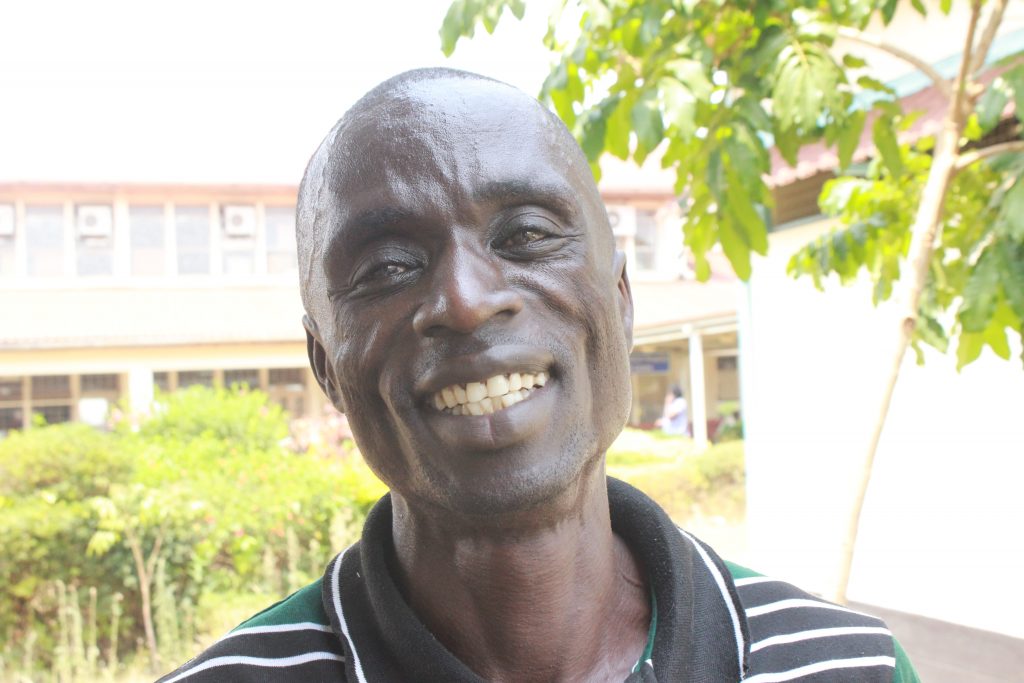
William at the Siaya County Referral Hospital
William is a man of indomitable will, a fighter in his own right. Having gone through so much, most people in his situation would have given up! The father of three knows too well the consequences of late detection of TB.
He recalls how in 2003, his wife began ailing, experiencing shortness of breath, fever, cough, weight loss and poor appetite. Living in Nakuru then, he took her to Nakuru Provincial General Hospital where an X-ray was done. She was diagnosed with tuberculosis and was immediately put on treatment.
“She took the prescribed medication, including injections for a period of six months but did not get better,” says William holding his chin. She passed away in 2004 and was buried at his rural home in Udonga, Karemo Division, Siaya County.
After mourning his wife’s death, William returned to Nakuru to continue with his tailoring job. In February 2006, he started experiencing symptoms similar to those that his late wife had. He began to cough, lost weight, had a fever and lost his appetite. He went to his rural home in Siaya and visited Siaya County Referral Hospital where a sputum test was done. The test was negative for TB. A chest X-ray later revealed that he had TB. He was exhausted, weak and in pain.
“I was not shocked by the diagnosis,” he says.
He was immediately put on medication. “That night, I slept well. I felt so much relief. I even had an appetite for food!” he says with a smile. He took the prescribed TB medicines for six months without fail and tested negative at the end of the treatment period.
In October 2011, he once again began to experience the same symptoms. This time around, he visited Langa Langa Health Centre in Nakuru. A sputum test did not reveal anything. He was then referred to Nakuru Provincial General Hospital. Once again, a chest X-ray revealed that he had TB and was again put on medication for six months. He did not see much improvement and his symptoms persisted. He went back to the hospital, and a second sputum test showed that he still had TB.
He was re-treated and was put on both tablet medication and injections. This treatment lasted eight months, from May to December 2012.
After the third phase of treatment, William did not get any relief. By February 2014, he still felt weak and was sweating profusely. His health kept deteriorating.
Final Road to Recovery
In April 2014, his condition got worse and he became very weak. He was taken to hospital by members of his church and was admitted. He had a severe headache that would not go away. On testing through a spinal tap, he was found to have meningitis and was admitted in hospital for one month.
He went back to Siaya and once again, started feeling ill. He sweated profusely and coughed endlessly for two weeks.
“The disease really put me down, I could not even stand up on my own. I would only get relief after throwing up,” he says.
His mother sent for a private doctor to treat him at home. He was given an intravenous injection, but did not getting better. He was referred to Deborah Asewe, a Clinical Officer at Bar Agulu Dispensary who specialises in skin and lung health. Due to his condition, Deborah had to attend to him from home (Directly Observed Therapy). William tested positive for malaria. A sputum test was also done but it turned out negative.
“I knew I had TB,” William says. He was well aware of his situation. He was referred to Siaya County Referral Hospital for a chest x-ray and he tested positive for TB. A GeneXpert test showed that he had Multi-Drug Resistant (MDR) TB. Since he was not responding to Rifampicin, a drug used to treat TB, a drug sensitivity test (DST) was done and new medication prescribed.
He was still feeling very weak but began treatment immediately. This time around, he was put on medication for twenty months – both injections and tablets. It was not easy, and he suffered some side effects at the start of his treatment like nausea. Towards the end of the 20-month treatment, a chest-X-ray was done, and he tested negative for TB.
William is now TB-free. He states that TB is treatable. One needs to adhere to treatment and have faith that all will be well.
He is now an ardent TB advocate and always avails himself when called upon to talk at events such as the World TB Day commemorated on March 24 every year.
USAID Support to Find People With TB
With funding from USAID through the Tuberculosis Accelerated Response and Care (TB ARC) activity, CHS has been working with the National TB, Leprosy and Lung Disease Program (NTLD-Program) to find more people with TB through Active Case Finding. In Siaya County, 509,646 people were screened for TB between September and December 2017. Out of the screened population, 580 people were diagnosed with TB and put on treatment. Through the TB ARC activity, CHS seeks to support the NTLD-Program to expand access to quality-assured TB services in all the counties by ensuring that all TB cases are identified and treated.