
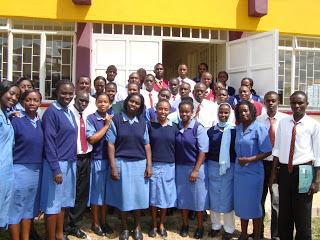
Tuberculosis among students in learning institutions is prevalent. They are at a high risk of exposure to TB owing to the congregate setting within such institutions. This is even worse when the institution is a boarding facility. This was the case with Rose*, a medical student in Kakamega.
A tall astute lady approaches with a shy look on her face. She adorns long braids and a pair of azure blue jeans trousers. After a light chat, she narrates her struggle and triumph over TB.
Rose* , a college student, recalls how in 2013 while in Form 3, she was informed that her father was unwell. When she went home for the school holidays, her father had been admitted at Tenwek Hospital. He had been diagnosed with TB and was very weak and had a very bad cough. He also had difficulty breathing.
“I did not even get to see him that holiday. He did not come back from hospital. The next month, he died!” She says, tears lingering in her eyes.
In February 2017, she developed a cough, had headaches and night fevers. She self-medicated with Amoxil and Paracetamol, got some little relief but with time, the symptoms persisted. At that time, she was home in Bomet and sought treatment at a private clinic. The doctor diagnosed her with rheumatic fever and was put on a daily injection for one week. The relief lasted a short while.
She did her research on rheumatic fever and found out that it only affects children between five and 15 years of age.
“I suspected that the diagnosis was not correct. I then stopped the medication after the fourth injection, but I finished the tablets,” she explained.
The holiday was over and she was to report back to college. Therefore, the doctor referred her to the Kakamega County Teaching and Referral Hospital for further assessment since her condition was not improving.
She went back to school and visited the Hospital for a second opinion. A malaria test and chest x-ray were done. The doctor diagnosed her with pneumonia. He later recommended that she have a TB test done as her symptoms persisted three weeks into treatment for pneumonia.
On May 17, 2017, a sputum test revealed that she had TB and she was immediately started on TB medication. She remembered how her father had succumbed to TB and did not want to follow that path.
“I would take four tablets at 8PM every day,” she explained.
One week into the medication, she was totally relieved of the headache and the cough. For two months, she was treated with anti-TB drugs Rifampicin and Isoniazid. A test was done, and the results were negative. For four months after that, she was treated with Pyrazinamide and Ethambutol. A TB test done two months later also returned a negative result. In November 2017, a final test was done and she tested negative yet again.
She recounts that it was only on one occasion that she forgot to take her medication. She had forgotten to carry her medication with her from college as she went home during the semester break. It was during the nurses’ strike and there was no one at the chest clinic at the Kakamega County Teaching and Referral Hospital to issue her with medication for the one day. Luckily, she met a Clinical Officer and explained her situation to him. He assured her that she would only need to continue the next day and would not have to start treatment all over again. The next day, she went back to the facility and got a new set of medicines. From then on, she adhered to her medication without fail.
“My mother was very supportive and encouraged me to take my medication without fail,” she said.
She calls on her fellow students who might experience similar symptoms to seek immediate medical attention because TB is treatable and curable.
With funding from USAID through the Tuberculosis Accelerated Response and Care (TB ARC) activity, CHS has been collaborating with the National TB, Leprosy and Lung Disease Program (NTLD-Program) and county governments to conduct active case finding so as to find more people with TB. With support from USAID, CHS is committed to supporting the NTLD-Program efforts to expand access to quality-assured TB services in all the counties by ensuring that all TB cases identified are treated.
*Name changed to protect the identity of the former patient