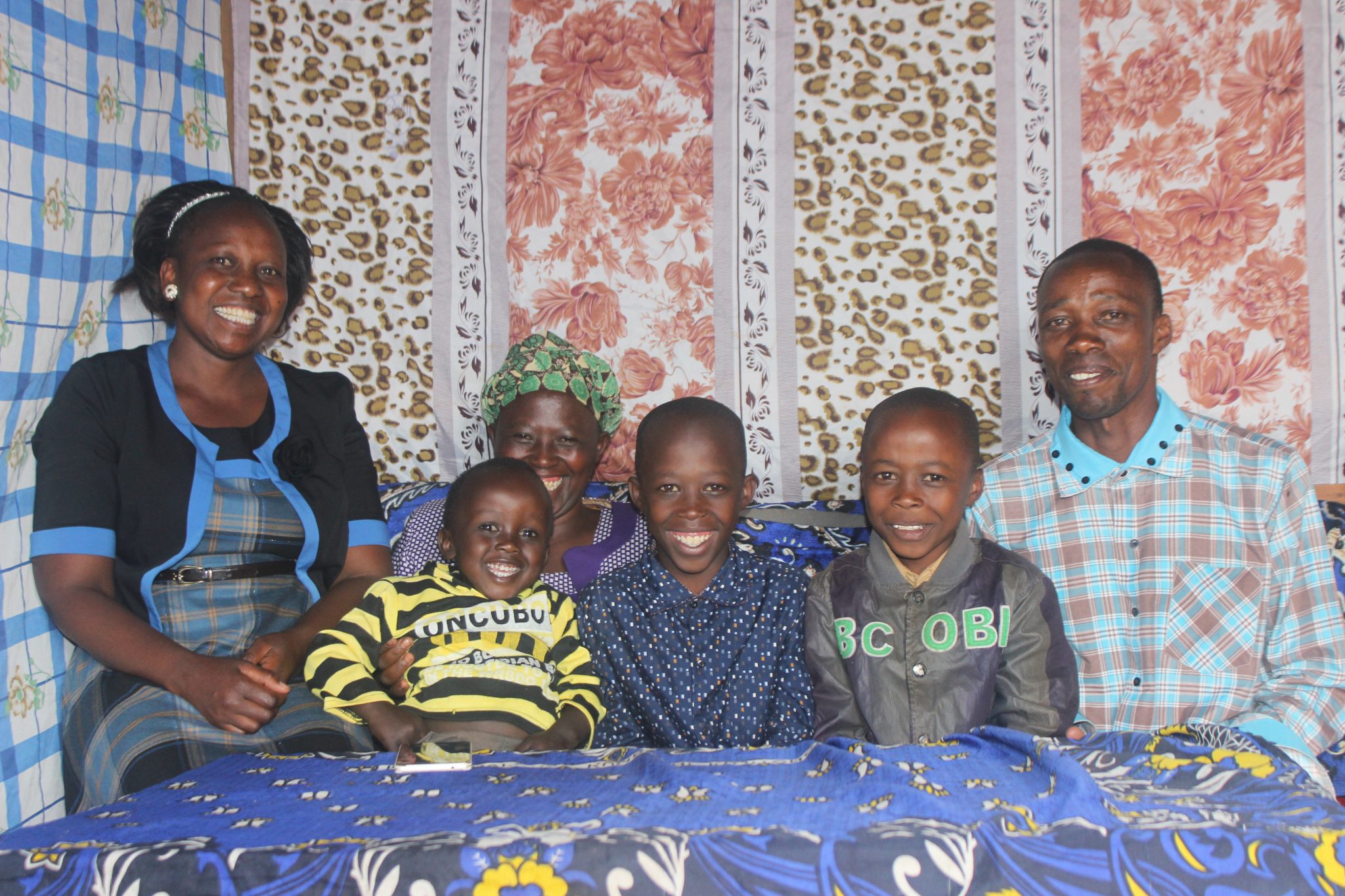
Inside a small semi-permanent house in Kuresoi, Nakuru County, three-year-old Enock Kibet clings on his mother’s neck as they giggle at each other. Shortly after, his father and two brothers join in and excitedly greet us.
“Despite our minimal resources that have led us to live here on this farm as squatters, we call ourselves the luck family. We have been to hell and back. These smiles you see on our faces right now were a rare gem in this home a few years ago. We wished for one then but we could not because of Tuberculosis that had set up a tent here. The disease saw people whom we regarded as friends desert us, as they feared we would pass on the bacteria to them. It was a really difficult time for us,” Lorna Kipkemoi, Enock’s mother, opens up.
Back in July 2016, Enock’s father Robert Kipkemoi developed a cough that he thought was as a result of the cold weather and would go away once the season came to an end. However, the cough persisted through the warmer weather prompting him to buy over the counter cold drugs at a local chemist.
“The drugs I bought in the chemist gave me a short-term recovery in the sense that once I was through with taking them, the cough would come back. I would go back to the chemist to buy some more and the cycle continued up to December 2016 when my wife advised me to seek treatment in the nearby hospital. By now my situation had worsened. I had lost a lot of weight, had night sweats, fever and the cough had worsened in that I was coughing blood-stained sputum,” Robert shares.
After several tests in the hospital, Robert was diagnosed with multi-drug resistant tuberculosis (MDR TB) and put on medication. “Being told I had MDR TB disturbed me a lot but a few weeks after taking the medication, I began regaining back my health. The cough, night sweats and the fever experienced minimised and I began gaining back my strength as days went by,” he says.
It is during this period that Enock was born, rekindling the family ‘s lost happiness with his presence and his father’s positive response to treatment.
One day they were visited by a group of health care workers who were carrying out tuberculosis contact tracing. “We had come to do tuberculosis contact tracing in this village in 2017. We passed by this homestead after the Community Health Worker alerted us that there was a two months old baby living with an MDR TB patient who they were treating and used to visit them frequently,” Emily Misoi, the area Sub County Tuberculosis Coordinator interjects.
“Luckily, we had recently undertaken a paediatric training organised by the National Tuberculosis Program and we wanted to do Continuous Medical Education. We found Enock coughing and we thought he was a good candidate to do the demonstration with for the healthcare workers. We invited Enock for tuberculosis screening at the hospital and that is when we discovered he had contracted MDR TB,” Emily continues.
During that period the healthcare workers realised that they were also treating the father as a patient of drug-susceptible TB. The challenge for treating Enock came in as there was no formulation for treating MDR TB in children. Upon contacting the National TB program, they were advised to refer Enock to Kenyatta National Hospital for treatment. Being the first youngest MDR TB patient at two months, Enock was admitted in the hospital and put on medication immediately.
The pharmacists at the Kenyatta National Hospital compounded the MDR TB adult dosage to get a formulation that they put Enock on. Five months later he was discharged and his subsequent treatment was to be administered from home after he responded well to the medication.
Apart from covering for their entire medical bill, the National TB Program further supported the family by offering them a monthly stipend of USD 120 for their daily balanced meals. They also supported the healthcare workers who visited them daily to offer medication and monitor their progress with transport.
After 20 months of treatment, Enock and his father fully recovered from MDR TB, however, they still go for clinical reviews on a monthly basis. The family is happy the TB has not reoccurred. Enock’s parents are preparing him to enrol in school next year. His father having regained his health has gone back to doing business to support his family.
Looking back, the family is grateful for the support they got, “If it were not for the support we got, this disease would have by now wiped out my family. The money spent on treatment is too high for a common man’s family like mine. We are truly thankful even for the guidance I got on how to prevent the spread of the disease to the other people especially my wife and children whom I interacted with most,” he concludes.
Centre for Health Solutions-Kenya through the USAID funded Tuberculosis Accelerated Response and Care (TB ARC II) activity is continuing to support the National TB program to reach families like Enock’s with an aim of reducing the incidence, and TB related morbidity, and mortality in line with the 90-95-0 targets to End the TB epidemic in Kenya.
The activity is a follow up of its predecessor TB ARC which had adopted collaborative approaches to finding more people with TB, supported and rolled out better diagnostic services and, initiated relevant and effective capacity building approaches for health care providers alongside many other innovations.